Article Tag

How AI Advancements Are Changing Creative Development

As the whole world has come to know, Artificial Intelligence is rapidly changing the way we live, work, and communicate. Nowhere is this paradigm shift more immediate or profound than in the commercial and advertising industries. Here, the AI revolution has totally altered the relationship between advertising agencies, directors, and creative studios.

​

Only a few short years ago, generative tools like ChatGPT, Claude and Midjourney were just beginning to break into the public consciousness. Their early image generation capabilities, then in their infancy, were marked by strange textural choices and distorted anatomy. They were glorified novelties - toys people played with online out of curiosity or for quick comedic experiments on social media. Yet gradually, and then all at once, these tools have matured exponentially. We’ve watched in real time as they transitioned from a quirky internet phenomenon, quietly slipping into the daily craft of commercial treatment development. 

‍

In the interest of saving time...

We’ll only be touching on AI’s influence on the visual process here. But there’s still a lot to say about its pervasive impact on creative writing, with our studio receiving an increasing number of repetitive prompt-generated scripts and production breakdowns month after month, raising serious questions about the future of copyright safety and original advertising.

​

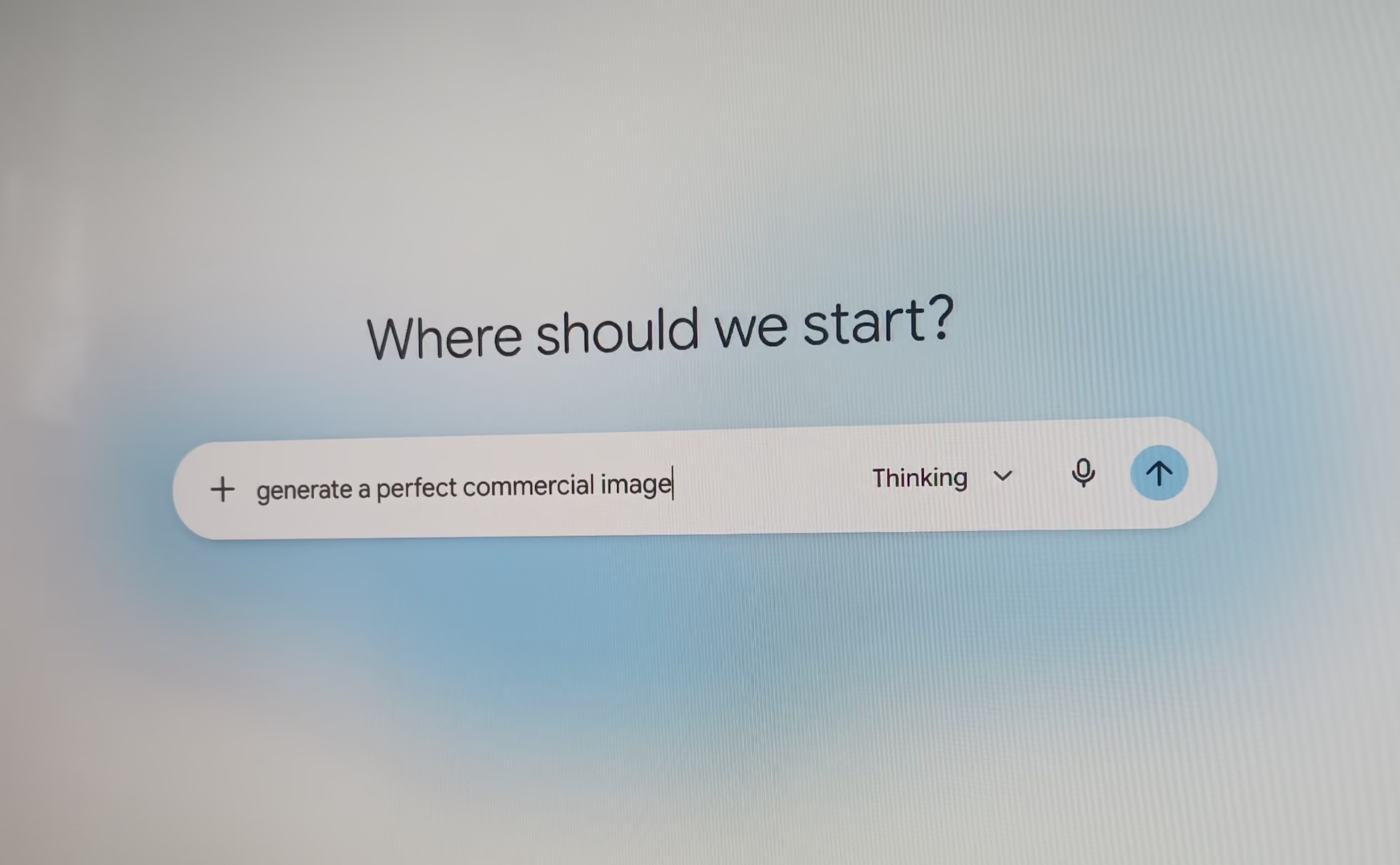
Its convenience visually is undeniable, allowing researchers and art directors to render complex commercial ideas in a matter of seconds, rather than relying on days of laborious searching through massive archives of films, commercials, and photography. At first, these synthetic generations may have lacked depth and fine detail, struggling to compete with careful composites, but gradually they’ve developed. Today, no matter how surreal or abstract the idea, AI can interpret it into an image.

‍

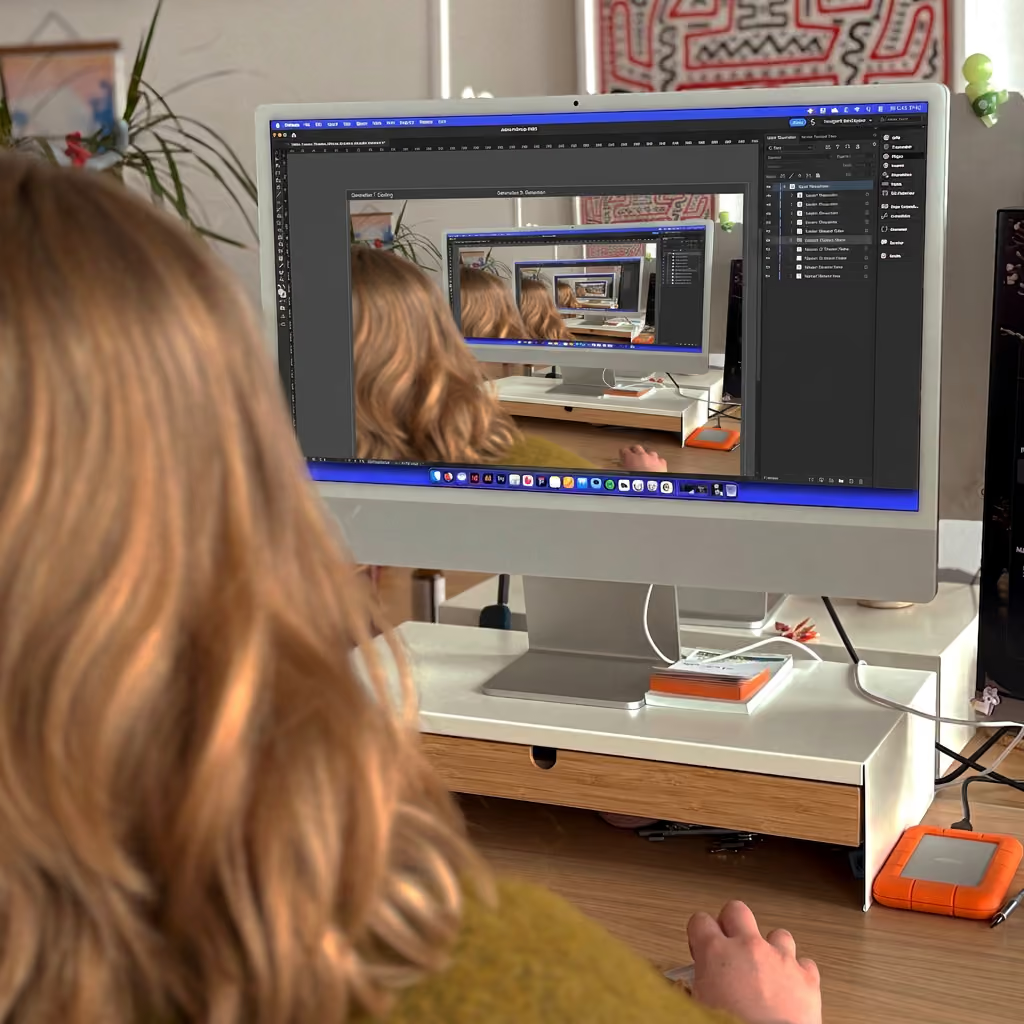
It’s that literal generative ability that has captivated commercial creatives in recent times. Rather than painstakingly combining disparate references to give the impression of a narrative idea, we now skip ahead to visualising it in a single, fully integrated AI image. Fundamentally, this has changed the traditional role of visual research in the pitch deck process. It has slashed the need for intricate image composites and exhaustive searches for unusual script beats. Software like Photoshop, the workhorse of picture editing, has been pushed ever more into the background, frequently overshadowed by the overwhelming speed and convenience of single-sentence prompts.

‍

Still, AI lacks the nuanced human sensitivity required to fully interpret a director’s distinct personal style into something totally “new” - or least, it lacks the ability to do so in the tight three-to-five-day turnarounds that are typical of treatments. Perhaps, if the technology ever reaches the point of true artistic self-awareness, directors will stray away from using it altogether or risk becoming the next replaceable part in the production pipeline. But for now, creative development has evolved into a careful balance of traditional visual research and practised image generation, using a huge collection of AI tools with varying specialisms.

​

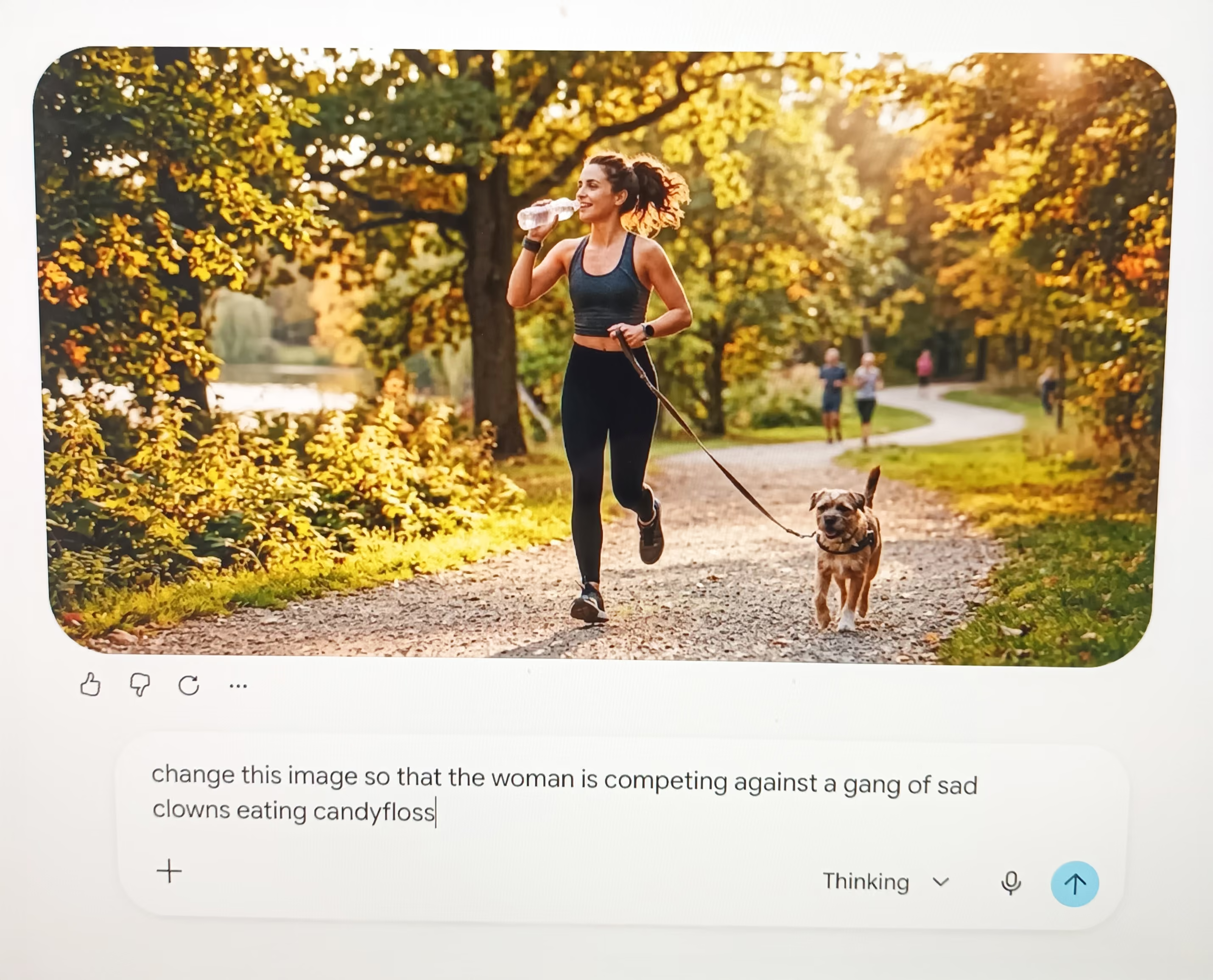
There is a certain level of entertainment that comes from utilising these tools - generating vivid impressions of a concept with text prompting alone, no matter how bizarre the outcome or oddly impractical the wording. A photorealistic image of a deep sea diver emerging from a kid’s playpool in a suburban German garden is just one example from this studio. Yet, as the novelty fades, its pitfalls have also become glaringly clear to our studio, and a quiet crisis of visual cannibalisation is emerging.

Intrinsically, AI imagery lacks true originality

Though on the surface, this might not be an immediately fatal flaw. Directors have always cited the work of other artists, drawing inspiration from cinema, photography and fine art. A fundamental part of the traditional visual research process is finding material that motivates their approach, which they can then draw from to support their creative decision-making and craft something that has unique qualities. The goal is never to copy, but to find elements that can be reassembled through the director’s personal lens to visualise their imagination in a pitch deck.

​

The adoption of generative AI breaks this chain of authentic inspiration. It has become a rarity for our studio to receive a brief that is not, in itself, already full of AI-generated content. While these images succeed in literally visualising the basic script beats an agency has set out, their synthetic origin stands out, often setting an uninspired tone mixed with warped expectations. They typically have a distinct, hyper-polish that never quite emulates the analogue world and authentic expression. They are fundamentally one-dimensional, and when these images are used as the basis from which directors are expected to draw inspiration, we create an insular feedback loop. References begin to cannibalise references, which are then fed back into the system once again. This cycle of AI reference material gradually drains creative originality, flattening aesthetic diversity and producing commercial work that looks and feels uncannily familiar.

‍

It’s something we already navigate with some sensitivity, but rejecting AI entirely is not the answer, especially as some of our clients feel enabled by these tools and many agencies insist their teams use them. Its operational benefits are obvious and undeniable, but for us it’s best implemented to enhance real, original visual references to build a picture with depth, tone, and honest human emotion. “Augmentation over generation” feels the best rule to work towards - a hybrid approach that ensures a human touch distinguishes every pitch and communicates a unique direction. Building treatments on a foundation of genuine photography and film stills ensures they carry inherent weight and a sense of atmosphere that only comes from real creativity and authentic expression. AI then functions as a paintbrush, rather than the painter, enhancing ideas without wiping away their soul or detracting from the director’s vision.

This ambition to automate the creative process has extended far past the initial pitch, with some brands and agencies already using AI to produce entire ad campaigns. Rather than using these tools to facilitate storyboarding or visualise developing ideas, we’re now seeing more and more instances where AI is bypassing the traditional production pipeline entirely. Companies as big as Coca Cola are opting to eliminate live-action shoots and produce ads using artificial talent and generative video models. Or at least, claiming to…

​

The cost-saving incentives for big brands to do this are clear, promising infinite assets while slashing the working expenses normally associated with huge production crews, locations, and post houses. But these corner-cutting ads suffer from the same uncanny valley, stunted creative and lifeless over-polish we see in the creative development stage. These campaigns might capture consumer attention through the sheer novelty of their creation, but as we’ve seen online, this attention is rarely positive. Without the lived-in experience and subtle imperfections that come with real human creation, wider audiences simply fail to connect with these films on an emotional level, which is really the key to good advertising.

‍

​The real value of creative direction...

​The real value of creative direction isn’t moving towards who can write the most efficient prompts, but who has the discernment to recognise when a visual feels authentic and more importantly, when it needs to. Taste and subtext can’t be automated. By treating AI as a supportive tool rather than a substitute for art, we protect the balance between inspiration and production that is vital for the future of commercial storytelling. Agencies don’t want a visual echo of their own scripts sent back to them. They want a fresh vision elevated by honest human perspective. Moving forward, the studios that thrive will not be those that give themselves over entirely to AI technology, but those that can use it to amplify the best of human craftsmanship.